The world dynamics are different now
12/03/2025 - 10:02

- Stories
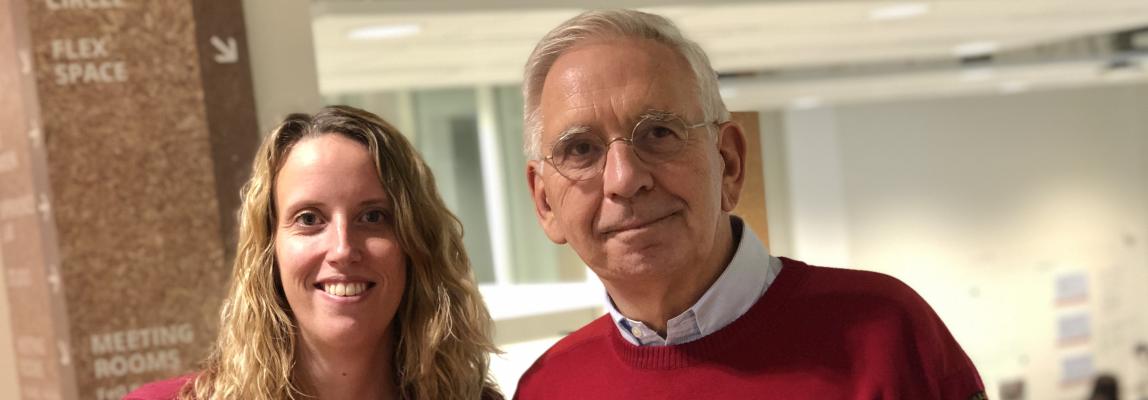
Jan Willem: ‘I started as a student at VAT. If you include that, it’s well over 50 years.’
So you were one of the first students who started studying at the Verkeersacademie (Traffic Academy) in Tilburg in 1972?
‘I was in the very first cohort, 90 students, nine staff members. That is 1 in 10. Not quite, there were some part-timers, but “small scale” was already a buzzword at the time. We had a lecturer of Psychology, which we still had back then; that chap came to teach one hour every week, and off he went again.’
Annemiek: ‘Verkeersacademie?’
Jan Willem: ‘That’s what it was called at the time. It wasn’t only Traffic Engineering; it also offered the Spatial Planning specialisation, and Logistics. I graduated on containerisation at NS (Dutch Railways). Can the goods that are transported by NS be fit in a container? The answer was: Yes.’
That is the shortest summary of a thesis I have ever heard.
‘We do not have any more room in that Alumni Newsletter, do we?’
Not long after completing that thesis you started teaching at VAT yourself. How did that happen?
‘I wanted to work at Shell after I graduated. I thought “I know everything about containerization”. It seemed like a good plan. Yet, my graduation supervisor said that I had to move on to further study. Then I did the Master Economics in Tilburg. There were no transfer master’s programmes at the time as we have them now – everything is better now.’
Annemiek: ‘You don't hear that very often.’
Jan Willem: ‘It is not entirely true. But okay, I did that master’s programme and started teaching Economics at VAT, the basics. I was able to do that, they thought. That was in 1976.’
So you started as a lecturer?
‘Consecutively – and sometimes simultaneously – I was a lecturer, placement coordinator, programme manager, an academy director, member of the central management, and professor.’
That’s how it can go, Annemiek 😊
‘Funny, I was just calculating; Jan Willem is twice as old as I am. But he was way younger when he started teaching!’
Because you started working in the professional field immediately after your studies in Enschede?
‘That’s right. I studied Technische Bedrijfskunde in Enschede. That programme was also offered in Eindhoven, and since I come from Bergen op Zoom, that was my plan. Then my mother said that I needed to take a look in Enschede, and so I did. You can live on campus there, the sun was shining, it seemed like a holiday park. I thought at once: I’m going to that place.’
Jan Willem: ‘Nice to hear; programmes get a certain smell and colour in students’ perception. The VAT also had that small-scale character, and yet, students came from all over the country.’
Annemiek: ‘And because everybody came from further away places, we didn’t go home every weekend.’
Jan Willem: ‘Recognisable. What did you graduate in?’
Annemiek: ‘Eventually, I graduated in Supply Chain Simulation. That was for my master’s.’
Look, that’s where your stories start to converge.
Annemiek: ‘I did the Industrial Engineering and Management master’s programme. It was a two-year technical master’s, during which it was possible to take electives in the third semester. I did them in Munich. I enjoyed myself there, and stayed for three years. I found a company offering me to do my graduation project there and after my master’s degree, I started working at a small Enterprise Resource Planning consultancy firm and afterwards, at Philip Morris. No, not in Bergen op Zoom; in Munich. I’m not interested in smoking at all, but the job was interesting.’
And how did you eventually end up at BUas in Breda?
‘After a bit of wandering, literally, since I mostly worked at international businesses and did some factory planning in Italy, the UK and Spain. People were pleased with me; I understood the processes behind the systems. It wasn’t always easy, as a young woman in a world that I experienced as rather conservative. I got a burnout and started to rethink things. It was never my intention for things to turn out that way.’
Jan Willem: ‘Good to hear you say it like that. When I look back, I also think that it has never been my intention for things to turn out like that. Things go the way they go.’
Annemiek: ‘Perhaps it was just simply meant to be. I eventually ended up teaching at a university of applied sciences through a career coach. My father is a teacher of German, so I suppose it’s in my DNA.’
Annemiek, if you were here, in my place, what question would you like to ask Jan Willem?
‘Of course I’d want to know what has changed in education.’
Jan Willem: ‘Nothing has changed, at the core. OK, you used to study for exams and the marks were displayed on the notice board for everyone to see. You could see exactly how you had done in comparison to others. Something like that is unthinkable now, with the privacy laws. Books were used; now we use papers and up-to-date documentation and practical cases. You used to take core courses, but now everything is offered in an integrated way. I’m not saying that one is better than the other; it’s just different. Personally, I’m glad that I can fall back on my basic knowledge. How do you do that now? You can only fall back on how things went in a particular case.’
Annemiek: ‘I recognise what you say about core courses; that was also the case in my student days. It works really differently now, and we have AI. That brings along completely new challenges.’
Jan Willem: ‘That’s also timeless. When calculators first became widely available, they were seen as something harmful. Things just keep repeating themselves constantly.’
Jan Willem, what would you like to give along to Annemiek?
‘I myself worked at Tourism for some time, and I would recommend everyone teaching at BUas to go and have a look at another domain. If you really like education, you would also like it in another context, and you learn an awful lot from such a different blood group. Anyhow, it is good to gain experience in as many environments, organisations, and boards as possible.’
But Annemiek already has ten years of work experience!?
Jan Willem: ‘That will see you through the next five years. Make sure you stay up to date with developments in the subject area. Supervising work placements would help with that. Are you already doing that?’
Annemiek: ‘I’m going to start with that next semester.’
Jan Willem: ‘You get to see so many businesses from the inside. Much of my knowledge about logistics comes from students and students doing their graduation project.’
What do you like most about teaching?
Annemiek: ‘Helping young people develop. If I can provide my lessons and a bit of coaching as a contribution, I’m happy.’
Jan Willem: ‘Working with young professionals. I’ve learned so much from that, and that’s what I’ll miss most: the dynamics.’
Annemiek: ‘I also connect well with students. They share things with me, they feel comfortable and safe, which is wonderful.’
Jan Willem: ‘The best thing is when you tell a story and you see their eyes light up. That aha moment.’
When you look back on your very first lesson, what do you see?
Annemiek: ‘I found it very exciting and was glad that I wasn’t standing in front of the group alone. I’m still trying to find my style.’
What is your style, Jan Willem?
‘I always start with a story. It sounds like lecturing, but I think it’s important that students get some background information before we start discussing it. Putting everything in context for a while, even when it comes to business practices. Not: this is how it is. But: this is how it is there.’
Annemiek, you can plan for the next five years, as Jan Willem has just said, and then? Something else?
‘It should not become a routine job of course, but first, I want to enjoy being a lecturer. I don’t even know what else is out there.’
Remember the list that Jan Willem has just mentioned 😉
What did you enjoy most about that, Jan Willem?
‘I enjoy setting up something new, such as the Master Supply Chain Management. Being a professor when no one knew what that entailed was also a challenge. In the beginning, it was mainly about managing content and translating that into education. Now it’s much more of a research role.’
And what are you going to do now?
‘Another year or so of giving guest lectures here and there and doing some administrative work, but I think you should really stop after that. I sometimes see former colleagues at such meetings who see it as a day out. You shouldn’t want that, I think, because the world dynamics are different now.’
Interview by Maaike Dukker - 't Hart