Where logistics meets the built environment: SPRONG LILS workshop explores research agenda

Where logistics meets the built environment: SPRONG LILS workshop explores research agenda

11/10/2026 - 10:20

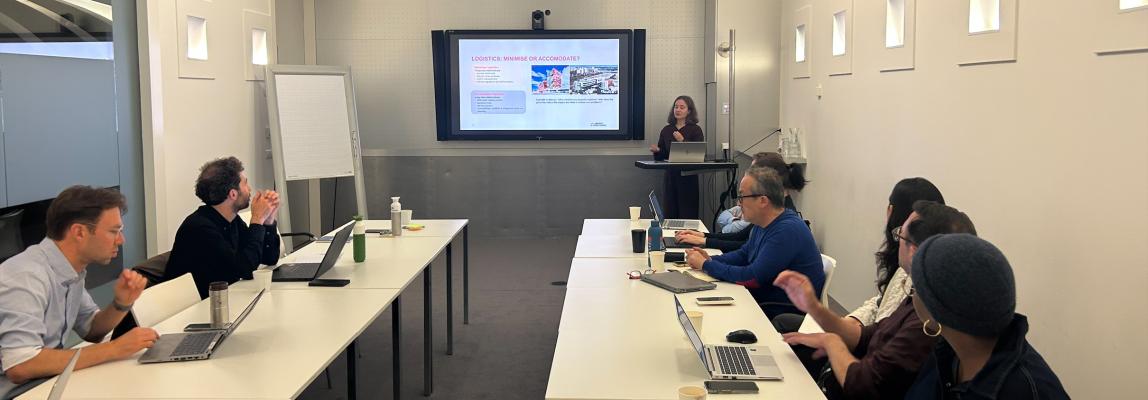
Every parcel, delivery and service van has to go somewhere, yet logistics is rarely part of the conversation when we design neighbourhoods and streets. Within SPRONG LILS (Low Impact Lastmile LogisticS), researchers and practitioners are working to change that. A recent workshop brought together experts from both fields for a critical and productive discussion on how logistics can be given a place in the built environment.
Logistics NL
  • Expertise

The aim of the day was to identify the most pressing research questions at the intersection of logistics and the built environment, as a foundation for follow-up projects and research.

Participants came from the SPRONG LILS partner institutions: HAN University of Applied Sciences, Van Hall Larenstein University of Applied Sciences, Breda University of Applied Sciences, Rotterdam University of Applied Sciences and Amsterdam University of Applied Sciences. They were joined by a representative from the Municipality of Utrecht, urban planners, designers, PhD candidates and logistics specialists.

Together they explored questions such as:

  • What happens when logistics meets urban space, and how does it shape neighbourhood and city design?
  • Where do conflicts with other urban functions arise?
  • What kind of economy do we support, and which choices determine the services and companies that get a place in the city?

These questions were examined at three scales: regional, neighbourhood and street.

The workshop’s results will inform the next steps in research questions and projects within SPRONG LILS.

Interested in collaborating? Please get in touch with the LILS team via Zhan Goosen ([email protected]).

About SPRONG LILS
SPRONG LILS (Low Impact Lastmile Logistics) carries out applied research for and with partners. Its aim is to make urban logistics more sustainable, while ensuring that logistics also facilitates the societal transitions that are needed.

To do so, LILS broadens the monodisciplinary, regional field of KennisDC Logistiek into a multidisciplinary, supra-regional one, drawing on the partner universities’ expertise in areas such as spatial planning, mobility, data, circularity and AI, behaviour and energy. Research is organised around four themes:

  1. Transition to zero emission (Transitie naar zero emissie)
  2. Space for logistics in the city (Ruimte voor logistiek in de stad)
  3. Data and models (digitalisation) (Data en modellen (digitalisering))
  4. Consumer behaviour and e-commerce (Consumentengedrag en e-commerce)