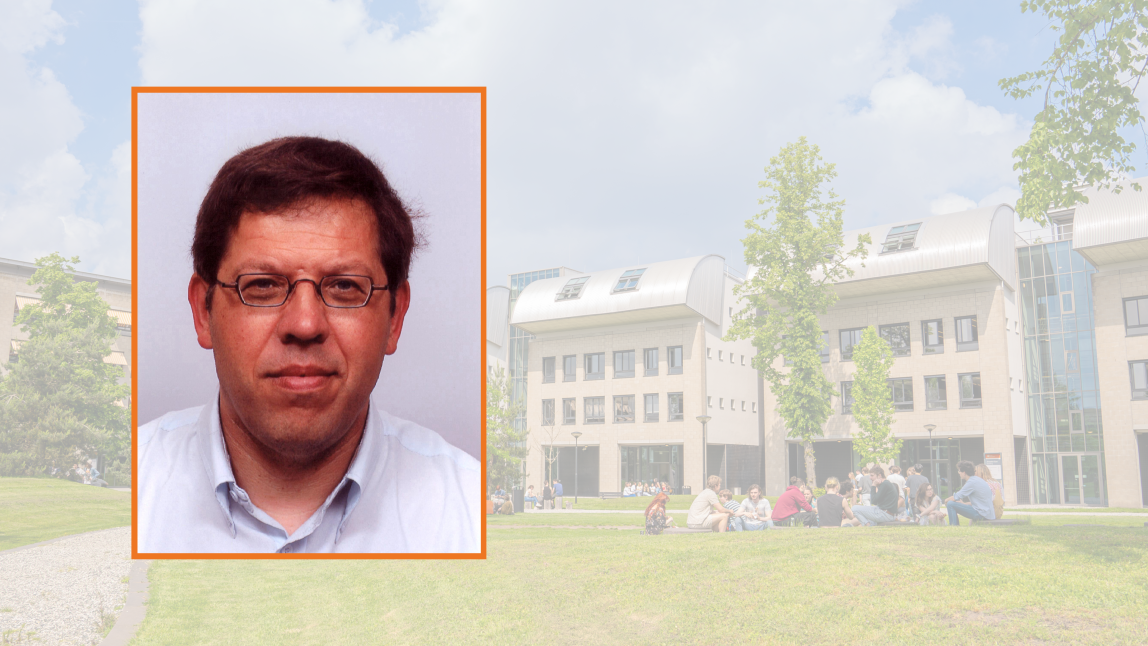
We can all learn from students’ optimism
06/03/2026 - 15:20

- Stories
‘When I began at NHTV (now BUas, ed.), which was in 1988, we neither had a PC, nor e-mail. We used to type exams on a typewriter or simply write them by hand and photocopy them. You stood in front of the class with a blackboard in front of you and a piece of chalk in your hand, and your students were frantically scribbling away to keep up with your notes or the slides on the overhead projector – does that ring a bell? A handy bit of equipment, that projector; apart from the bulb, there’s hardly anything that can go wrong with it.’
So that was old school, which is logical when you began as a lecturer around 40 years ago.
‘The field of expertise that I started out in, Logistics and Technische Vervoerskunde (Transport Studies), was actually quite new at the time. I originally trained as a mathematician and was appointed as a lecturer in Operations Research, a discipline that seeks to bring order to quantitative issues; and in logistics, there are a great many quantitative issues that need to be solved.’
Have you been teaching all these years or have you done other things as well?
‘I took a break for a while anyway; I fancied something different and worked for a consultancy firm from 2001 to 2004. I was the education manager there – that’s what the position was called – and my duties included delivering simulation training. But eventually, it all boiled down to selling software packages, which I found less enjoyable than teaching.’
So you came back?
‘My successor at NHTV had just left, so Leo (Kemps, ed.) was glad to have me back, and so was I. Ever since I was a child, I’ve been involved in acquiring and passing on knowledge; I enjoy working with young people and I love being in front of a group. If you can’t handle that, you’ll run away screaming.’
What have you learned from students?
‘That’s a good question; I wasn’t expecting that.’ (pauses to think)
‘I believe we can all learn from students’ optimism. For example, if very few students are admitted to a study programme, the majority of students think: oh, but I’ll be one of them. That optimism, the belief in one’s own abilities, the idea that anything is possible. But as a graduation coordinator, I’ve also seen the other side of things, where students do encounter themselves. Or run into difficulties in other ways, and that’s when you can really make a difference for them. I’m really proud that I’ve been able to help students.’
Can you give a concrete example?
‘Generally speaking, it’s often difficult for international students to find a suitable graduation host company; the language can be a problem, as can cultural differences. If you can then ensure that someone like that can still continue with their studies, you’re making a difference. I have lots of contacts in the professional field; I can give those students advice, tell them to have a look there – they’re bound to find something. And I can also contribute ideas for potential solutions and if they get stuck during their graduation project.’
What other things have you learned from students?
‘Indirectly, you also learn from your students how best to guide them. Should I dangle a carrot in front of them, or should I wield the stick? You can motivate students by saying, “You’re already doing well, but do bear in mind this and that.” But often the best way to help them is not to be too cautious – not literally with a stick, of course, but the mirror you hold up to them must be clear. And sometimes a student realises that it’s not for them after all, that the whole study programme isn’t a good fit. Choosing a study programme is a very difficult thing; I think of my daughter. She studied here too. By chance, I must say.’
Quite by chance 😉
‘Indeed. She had opted for a professional bachelor’s programme in Educational Theory, but after a month she said: “I don’t like it at all; all I’m doing is reflecting.” Then she wanted to study Management, Economics and Law, but by then it was October and she couldn’t join that programme that year. So she started with us with the idea of, ‘I’ll do a few modules in economics and law to see if that’s really the direction I want to go in,’ and then she stayed on and graduated as a logistics specialist in four years’ time. She now works as a Senior Planner at ProRail.’
Now back to BUas 60 years. What would you wish for the students?
‘I think I’m about to say something that many people won’t like, but please include it anyway: I would like to see knowledge acquisition and knowledge development take centre stage in the curricula once again. The focus is very much on the development of skills at the moment.’
You still speak to alumni often, don’t you? Do they ever mention that they’re missing that bit of knowledge?
‘That depends on how long ago they graduated.’ (laughs)
‘Before 2010, emphasis was definitely put more on knowledge. After that, it shifted towards skills. If you ask me, we reached our peak around 2015, with the right mix of knowledge and skills.’
And then.
‘And then came the campus, which has brought us so many wonderful things. That really was a brilliant move.’
Do you think it actually works the way we envisaged? I mean, the crossovers between the different study programmes?
‘It does, among the students though! They look out for one another and get on well. In my view, there’s still scope for more good crossovers in education. I’m thinking, for instance, of working with AI; that should be a common thread running through all study programmes even more.’
Do you work a lot with or for other study programmes or fields of expertise?
‘I used to help Frank (Peters, ed.) at the time when he was designing the Games programme; at the time, this was a brand new study programme for NHTV. I came from the world of simulation and was able to help him with that. And he needed a maths teacher, so I was added to the team of lecturers. “Are you a gamer yourself?” the first students asked me. “Not at all!” That was, of course, a bit of a let-down. It was lovely to see how open and honest students can be – that spontaneity. When they feel safe, they dare to say a lot, you know. And then I hold that mirror up to them again: ‘OK, you’re being critical of this or that now, but what was your own effort, what did you do yourselves?’
Are you going to miss them? The students? As you won’t be starting in September, will you? Or will you?
(laughs) ‘I am asked this every time, but it really is time for something different now. Of course I’m going to miss the students, and my colleagues too. They’ll miss me as well; I’m sure of that.’😉
Would you like to make an appeal to our alumni?
‘Yes, we’re still looking for a lecturer. A Supply Chain Analyst, as they’re called these days. With knowledge of algorithms, model-driven AI. If you’re the right person or know someone who is, please get in touch.’
Interview: Maaike Dukker-‘t Hart